HOW TO IMPROVE YOUR KICKS TRAINING AT HOME
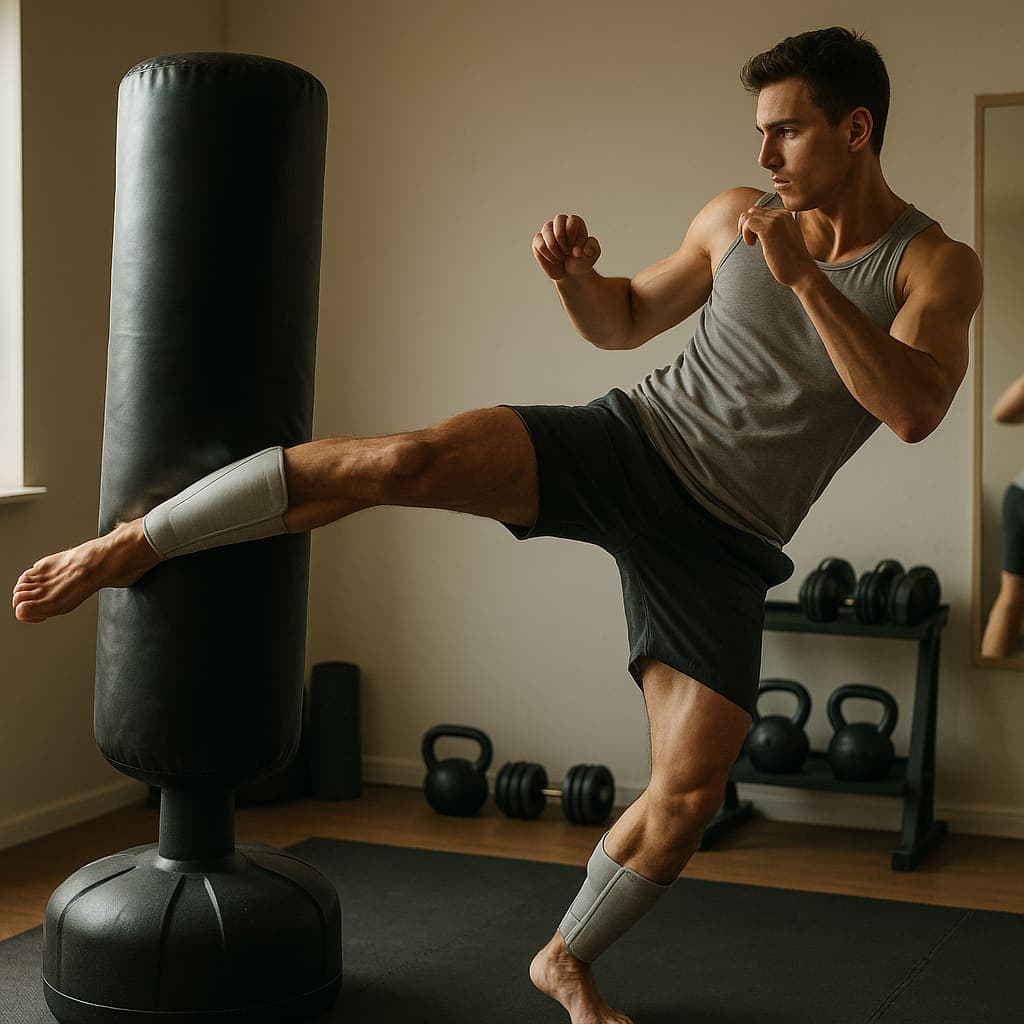
Training outside of the gym is a reality for most Muay Thai practitioners. Whether your gym only offers a few classes per week, you travel frequently, or you simply want to accelerate your progress, at-home training can meaningfully improve your kicks if you focus on the right drills. Nothing replaces live pad work and sparring, but there is genuine development available through focused solo work, and the kicks you bring to your next class will visibly improve.
Shadow kicking is the most valuable at-home drill you can do, and it is also the most neglected. Standing in front of a mirror in an open space, throw roundhouse kicks, teeps, and front kicks slowly and deliberately, paying attention to every detail of your form. Is your lead foot pivoting fully so your hip can rotate through the strike? Is your rear hand protecting your chin as you kick? Are you following through so your momentum carries your body around, or are you stopping the kick mid-path? Shadow kicking gives you time to notice and correct these issues without the pressure of a live training environment.
Hip mobility is the limiting factor for most people's kicks, especially those who sit at desks for long hours. The roundhouse kick requires hip external rotation, hip flexion, and a full range of motion through the kicking leg. If your hips are tight, your kicks will never reach head level with proper form, and your power generation will be limited. Daily hip mobility work, including deep squats, butterfly stretches, and dynamic leg swings, will produce noticeable improvements in your kicks within weeks. The Thai fighters who can casually kick opponents in the head have spent their entire childhoods developing this mobility through constant training.
Balance drills build the foundation for every kick. A kick is essentially a controlled fall onto one leg, with the other leg transferring its mass through a rotational path. If your balance is poor, you cannot generate power without falling off center, and you cannot recover your base to chain strikes together. Standing on one leg while slowly lifting the other knee, practicing single-leg squats, and holding kicking positions under load all build the stabilizing muscles around the ankle, knee, and hip that allow clean kicking mechanics.
Resistance band training is effective for building kicking strength and speed. Attach a band to a sturdy anchor point and loop the other end around your ankle. Throw slow, controlled kicks against the resistance, focusing on full range of motion and proper hip rotation. The band forces your kicking muscles to work through the entire kicking path, not just the impact phase. After several sets with the band, throwing unweighted kicks feels effortless and the speed increases noticeably.
Heavy bag work is obviously ideal if you have access to a bag at home, but even a moderately heavy pillow hung from a ceiling or a pool noodle held at kicking height can give you a target for practice. The absolute beginner mistake is to hit a bag as hard as possible with poor form, which only ingrains bad habits. At home, slow down. Kick the bag at fifty or sixty percent power while focusing on technique. Feel the kick land with the shin, not the foot. Notice how your base foot is positioned at the moment of impact. These details matter far more than how hard you can hit an immobile target.
Rope jumping builds the footwork and rhythm that underpin every kick. Five to ten minutes of jump rope before your kicking drills warms up your calves, activates your ankles, and puts you in a bouncing rhythm that translates to the dynamic footwork Muay Thai demands. Thai fighters jump rope for extended periods as part of their warm-up, and the practice is one of the most cost-effective ways to build the foundational conditioning kicks require.
Finally, study video. Watching slow-motion footage of fighters like Buakaw, Yodsanklai, or Superlek throwing kicks teaches you details that no coach can fully articulate. Pay attention to the preparation of the kick, the pivot of the base foot, the rotation of the hips, and the recovery after impact. Then try to reproduce what you see in your shadow kicking practice. This feedback loop between observation and practice accelerates your learning significantly, and it costs nothing beyond your time and attention.