FOOTWORK AND RING CONTROL IN MUAY THAI
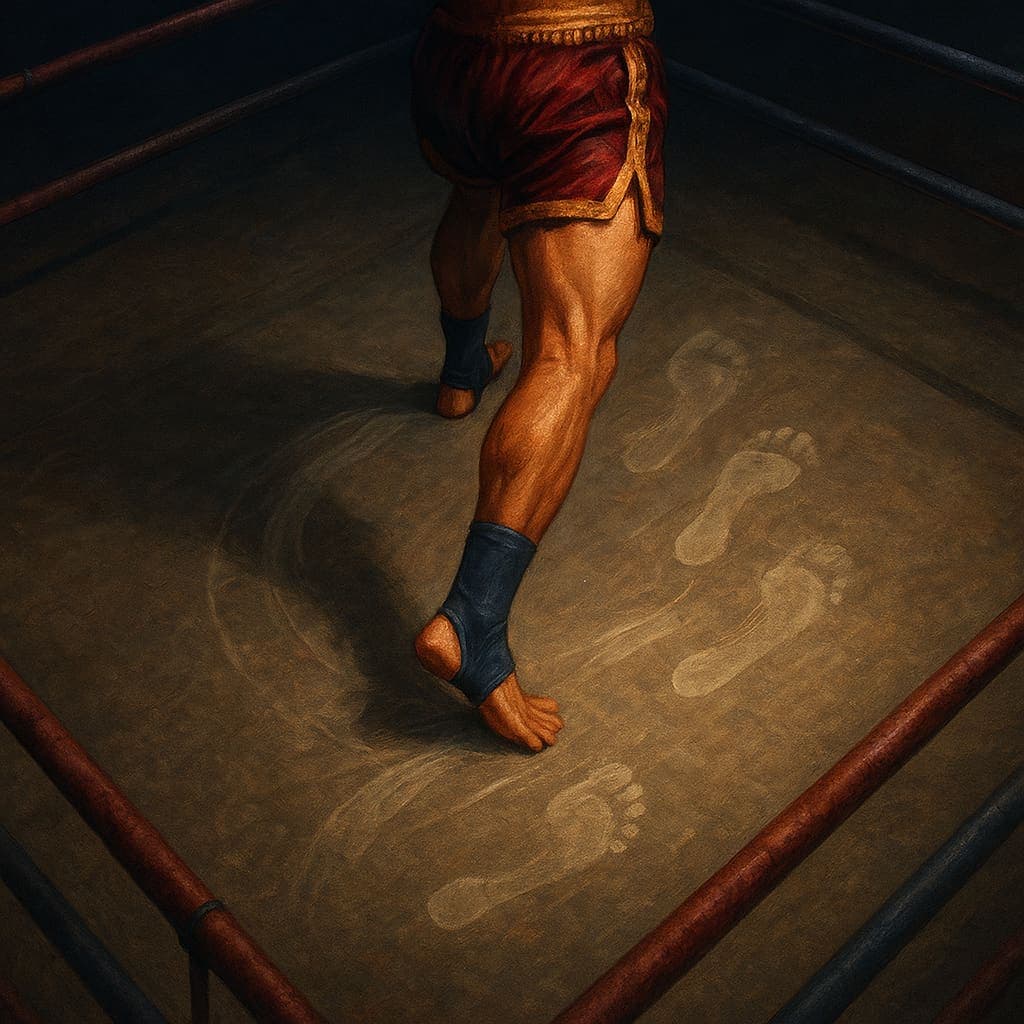
Footwork is the invisible skill in Muay Thai. Spectators tend to focus on the dramatic weapons, the head kicks, the elbows, the sweeping knees, but the fighters themselves understand that none of those weapons work without the footwork that delivers them into range and takes them out again. Great Muay Thai fighters are defined by where they put their feet. Ring control, angle creation, distance management, and defensive evasion all start from the floor up, and the fighters who master footwork tend to win consistently even against opponents with more dramatic physical gifts.
The Muay Thai stance is the starting point. Unlike the bladed, boxing-influenced stance that many new students adopt by default, the traditional Thai stance is more square, with the feet at roughly shoulder width, the lead foot pointing forward, and the rear foot angled out at about forty-five degrees. Weight distribution is relatively even, though slightly forward, and the knees are soft. This stance looks less dynamic than a boxing stance, but it is optimized for a sport that includes kicks and knees. The ability to check a low kick or lift a knee without losing balance is worth more than the slight punching advantage that a more bladed stance provides.
Basic footwork consists of small, controlled steps in all four directions, each led by the foot closest to the direction of travel. Moving forward, the lead foot steps first, then the rear foot adjusts to maintain the stance. Moving backward, the rear foot steps first. Moving to the right in orthodox, the lead foot steps first. Moving to the left, the rear foot steps first. At no point should your feet cross over each other, because a crossed-over fighter cannot defend a kick, check a strike, or counter effectively. The feet should slide across the floor rather than lifting dramatically. This keeps you balanced and ready to react.
Distance management comes next. Every Muay Thai fight happens in a series of ranges, and controlling which range you are in determines what tools you have access to and which tools your opponent has. A fighter with long legs and a good teep wants to fight at kicking range, where he can land clean kicks while his opponent cannot reach him with punches. A fighter with a strong clinch wants to close distance and trap the opponent in neck ties where he can knee and elbow. The fighter who successfully imposes his preferred range wins the fight.
Angle creation is what separates technical fighters from purely aggressive ones. Instead of standing directly in front of the opponent and trading, a technical fighter steps off the center line, creating angles where the opponent cannot return fire as effectively. A step to the right in orthodox places you outside the opponent's lead hand and opens a clean angle for a rear kick. A step to the left places you outside his rear hand and creates opportunities for counter kicks and elbows. These angles are small but decisive, often the difference between landing clean and eating a return strike.
Ring control is the cumulative effect of distance and angles applied over time. A fighter who controls the center of the ring while his opponent circles the perimeter is winning the footwork battle, and in traditional Thai scoring, this counts toward the decision. A fighter who can cut off the ring, trapping the opponent in a corner or against the ropes, can apply much more damage because the opponent has nowhere to retreat. Cutting the ring is done by stepping to the side rather than chasing directly, predicting where the opponent will move and arriving there first.
Defensive footwork is equally important. When an opponent attacks, the first response is usually to move, either backward out of range, sideways off the line of attack, or sometimes inward through the strike to smother it. The choice depends on the situation, but the fighter who can reliably disappear from the attacking zone without losing balance is very hard to hit cleanly. Sliding backward off a straight punch, pivoting away from a kick, or stepping off an angle to avoid a knee are all examples of defensive footwork that keep the fighter safe while setting up counters.
Drill footwork every single training session, even if it feels unglamorous. Shadow boxing with an emphasis on movement, pad work that includes stepping and angles, and partner drills that focus on distance management all build the skills that make other techniques work. The fighters who shine in live sparring and competition almost always turn out to be the ones who drilled footwork patiently when no one was watching.